Tang Sancai 唐三彩: The Colorful Ceramics of the Tang Dynasty
When people hear the name Tang Sancai (唐三彩), many immediately assume that these ceramics only feature three colors. In fact, that assumption is not entirely correct. The word sancai (三彩) literally means “three colors,” but the term actually refers to the technique of using multiple glaze colors rather than the number of colors themselves. In addition to the most common yellow, green, and white, Tang Sancai can also feature blue, brown, purple, and even black.
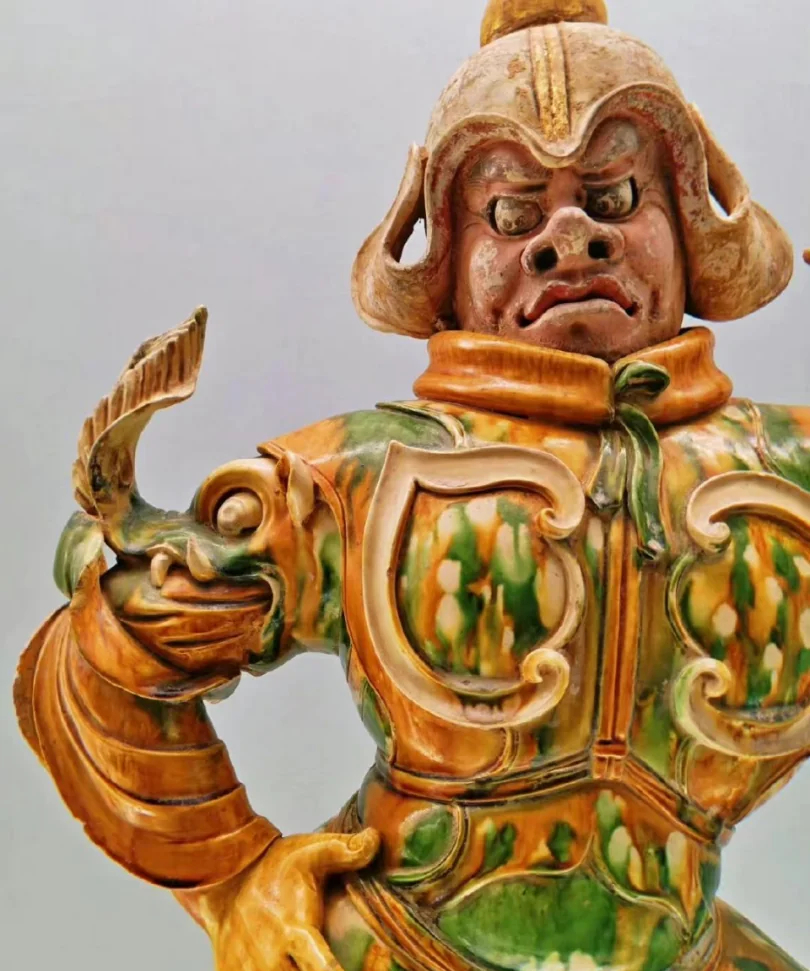
Tang Sancai (唐三彩 ; táng sān cǎi) is a type of low-fired lead-glazed ceramic that flourished during the Tang dynasty. It developed from the tradition of lead-glazed ceramics of the Han dynasty and became one of the greatest achievements in the history of Chinese ceramic art. Tang Sancai first appeared during the reign of Emperor Gaozong, reached its peak during the Kaiyuan era under Emperor Xuanzong, and gradually declined after the Tianbao era. It also had a significant influence on the development of Song Sancai and Liao Sancai.
During the firing process, the lead glaze melts and flows, allowing different colors to blend naturally and create rich, layered color gradations that make each piece unique. Because many Tang Sancai works were unearthed in Luoyang, these ceramics are also known as Luoyang Tang Sancai. In 2008, the firing technique of Tang Sancai was officially designated as a National Intangible Cultural Heritage of China.
Why Did Tang Sancai Emerge?
The emergence of Tang Sancai was supported by several important factors. First, advances in ceramic technology during the Tang dynasty made it possible to produce high-quality ceramics with increasingly sophisticated glazing techniques. Second, the growing tradition of lavish burials among nobles and government officials created a greater demand for funerary objects. Third, the prosperity of the economy, the flourishing trade along the Silk Road, and the cultural openness of the Tang dynasty encouraged the development of a more colorful, dynamic artistic style influenced by various foreign cultures.
Most Tang Sancai pieces were made as Mingqi (明器 ; míng qì), objects buried with the tomb owner as provisions for the afterlife. Only a small portion was used as architectural decoration or household furnishings.
How Was Tang Sancai Made?
Tang Sancai was made using a two-stage firing process.
First, the ceramic body was formed from white clay rich in kaolin or porcelain clay, then fired at approximately 1,000–1,150°C to produce an unglazed ceramic body. After that, the surface was coated with colored glaze and fired again at around 800–900°C.
Because the glaze contains lead as a flux with a relatively low melting point, the glaze melts, flows, penetrates, and blends together during the second firing. This process creates a surface where the colors appear to flow naturally, producing rich patterns that are never the same from one piece to another.
In general, the production process consists of six stages:
a. Material Selection (选料 ; xuǎn liào)
High-quality clay or porcelain clay is selected, cleaned of impurities, and processed into a fine material.
b. Forming the Ceramic Body (成型 ; chéng xíng)
The body is shaped using wheel throwing, molding, or hand modeling, and then left to dry.
c. First Firing (素烧 ; sù shāo)
The ceramic body is fired to produce an unglazed ceramic body.
d. Glazing (挂釉 ; guà yòu)
The surface of the ceramic is coated with the prepared colored glazes.
e. Glaze Firing (低温釉烧 ; dī wēn yòu shāo)
The ceramic is fired again so that the glaze melts and forms the distinctive colored surface of Tang Sancai.
f. Final Finishing (开相 ; kāi xiāng)
On human figures or sculptures, the unglazed parts of the head receive the finishing touches, such as coloring the lips with red pigment and painting the eyebrows, eyes, beard, and hair with ink to enhance the figure’s expression.
The Uniqueness of Its Glazing Technique
The uniqueness of Tang Sancai lies in its glazing technique. The glaze was made from a mixture of minerals containing iron, copper, cobalt, and manganese as coloring agents, while lead served as a flux and also gave the surface its glossy finish.
These metal oxides produced a variety of colors, including yellow, green, white, blue, brown, purple, and black.
Forms and Functions
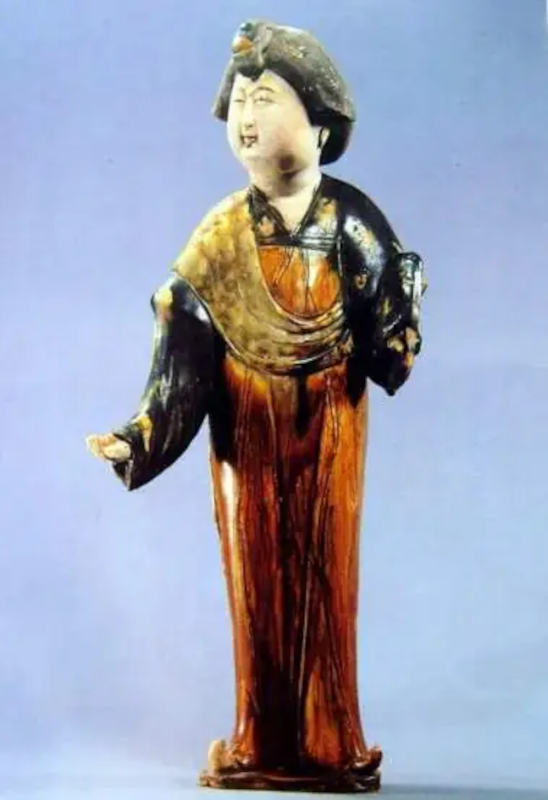
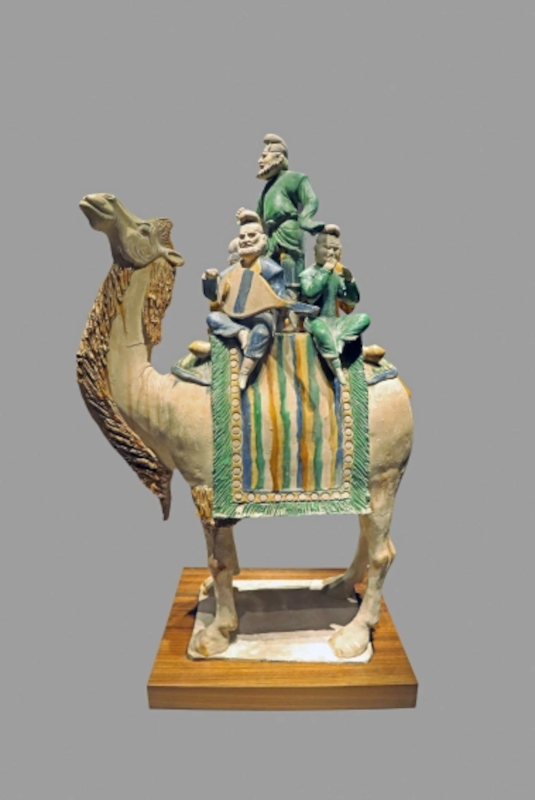
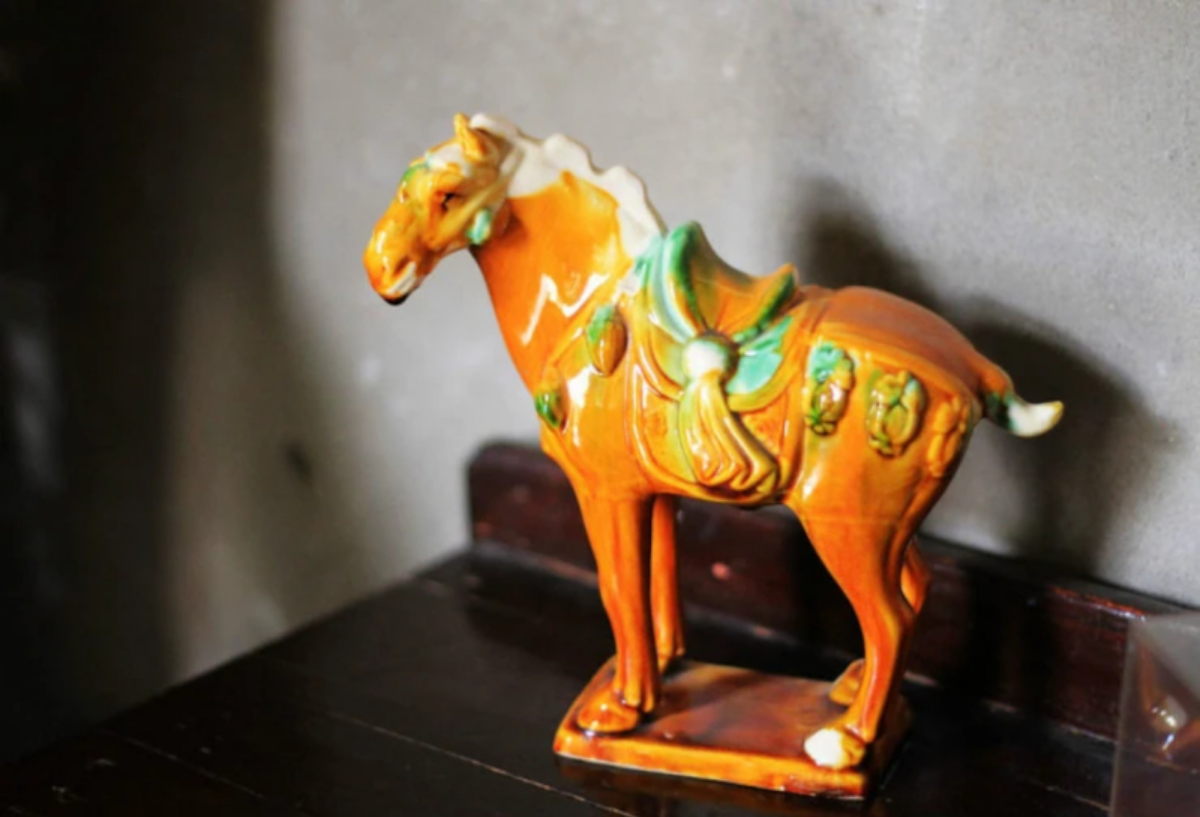
Tang Sancai was produced in a wide variety of forms. Its main categories include:
- Human figures
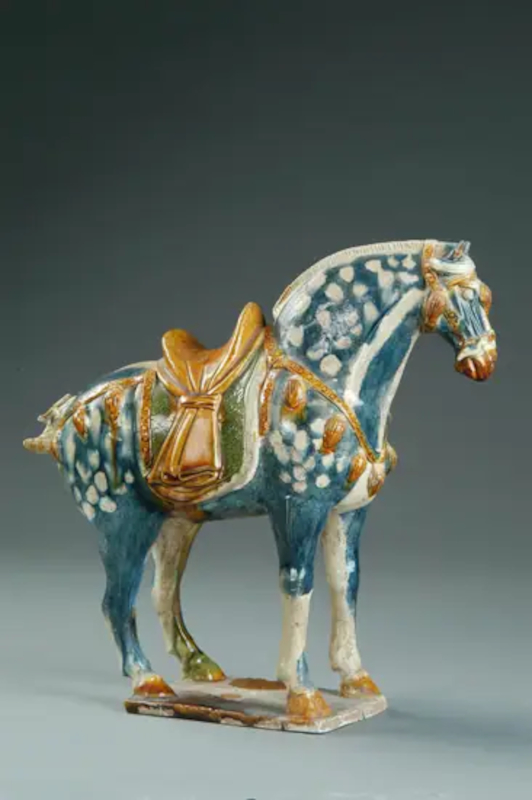
- Animal figures, especially horses and camels
- Models of buildings and utensils
- Architectural components
Tang Sancai horses are generally depicted with large, powerful bodies, while camel figures often carry trade goods or groups of musicians, reflecting the importance of the Silk Road and the trade connections between China, Central Asia, and the Western Regions.
Artistic Value and Cultural Heritage
Tang Sancai is renowned for its dynamic and realistic forms, especially its human figures, horses, and camels. The naturally flowing glaze gives each piece a unique color pattern that cannot be reproduced exactly. In addition, the figures of Central Asian merchants, camels carrying goods, and foreign musical instruments demonstrate the profound influence of the Silk Road on the culture of the Tang dynasty.